Professional manufacturer of thermoforming machines.
Language
Professional manufacturer of thermoforming machines.
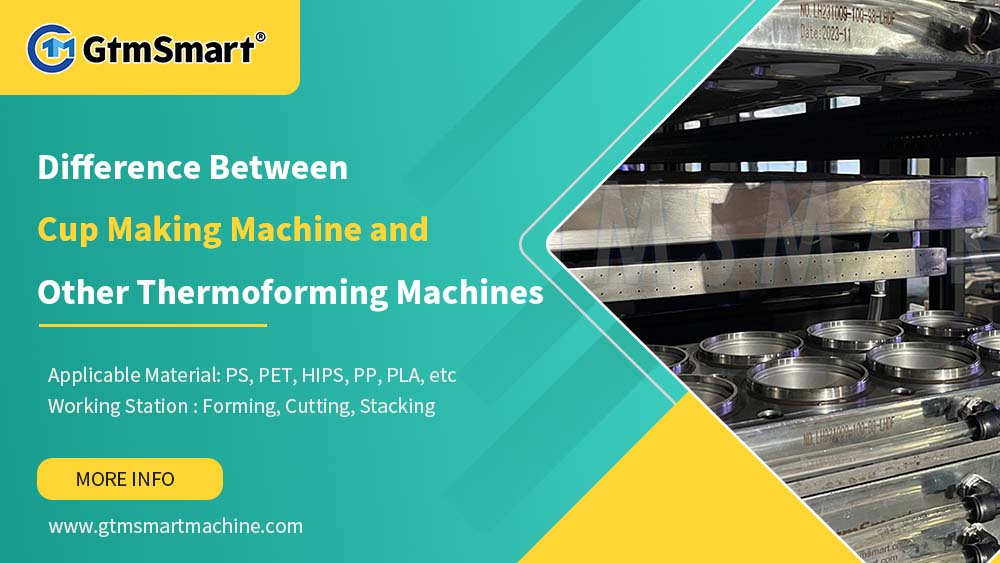
Thermoforming is a process of softening thermoplastic sheets by heating them and then molding them with molds, which is commonly used in the fields of food packaging, medical devices, daily necessities and so on. Plastic cup manufacturing machine is the main equipment specially designed for plastic cups. Other types of thermoforming machines (positive and negative pressure thermoforming machines, negative pressure thermoforming machines, etc.) are suitable for plastic lunch boxes, cup lid machines, trays, etc.
2.1 The degree of equipment specialization
(1) Cup machine specialization
Plastic cup manufacturing machine is specialized in the production of disposable cups (such as PP cups, PS cups, PET cups, yogurt cups, etc.) equipment, its main features include:
It is suitable for cup or bowl products, and producing other plastic products is also possible, but the quality of the plastic products made will be almost better than other thermoforming machines.
(2) Flexibility of other thermoforming machines
General-purpose thermoforming machines (such as positive and negative pressure thermoforming machines, negative pressure thermoforming machines, etc.) are suitable for the production of a variety of plastic products, and their characteristics include:
A variety of plastic products: by changing molds, food trays, blister packs, lunch boxes, cup lids, etc. can be produced.
2.2 Mold structure and forming process
(1) Mould characteristics of plastic cup making machine
Multi-cavity molds (molding several cups at one time) are usually used to improve production efficiency.
(2) Mold characteristics of other thermoforming machines
Diversification of molds:
Single-cavity/multi-cavity molds: selected according to product requirements.
Complex structure: concave/convex texture, reinforcement, multi-layer structure, etc. can be made.
2.3 Production speed and automation degree
(1) Efficient production of plastic cup making machine
Production speed: 35 times/minute for empty machine, ultimately depends on the material and actual products
Molding height: 750-850mm, the specific height according to the customer's product recommended models
(2) Other thermoforming machines
Take positive and negative pressure thermoforming machine as an example
Production speed: 30 times/minute empty, ultimately depending on the material and the actual product
Molding height: 100mm
2.4 Material Adaptability
(1) Material range of disposable cup machines
Mainly for thin-walled materials: PS, PET, HIPS, PP, PLA, etc.
The thickness is usually 0.2~1mm, too thick material will affect the molding speed.
(2) Material compatibility of other thermoforming machines
Wider range of materials: PS, PET, HIPS, PP, PLA, etc.
1. Typical applications of disposable cup machine
Beverage industry: milk tea cups, coffee cups, ice cream cups.
Fast food industry: yogurt cups, jelly cups, instant noodle cups.
Environmental protection trend: biodegradable PLA cups.
2. Typical applications of general-purpose thermoforming machine
Food packaging: fast food boxes, fresh trays, cake boxes.
Medical supplies: pill trays, surgical instrument packaging.
Industrial field: electronic component trays, automobile interior parts

Professional manufacturer of thermoforming machines.
